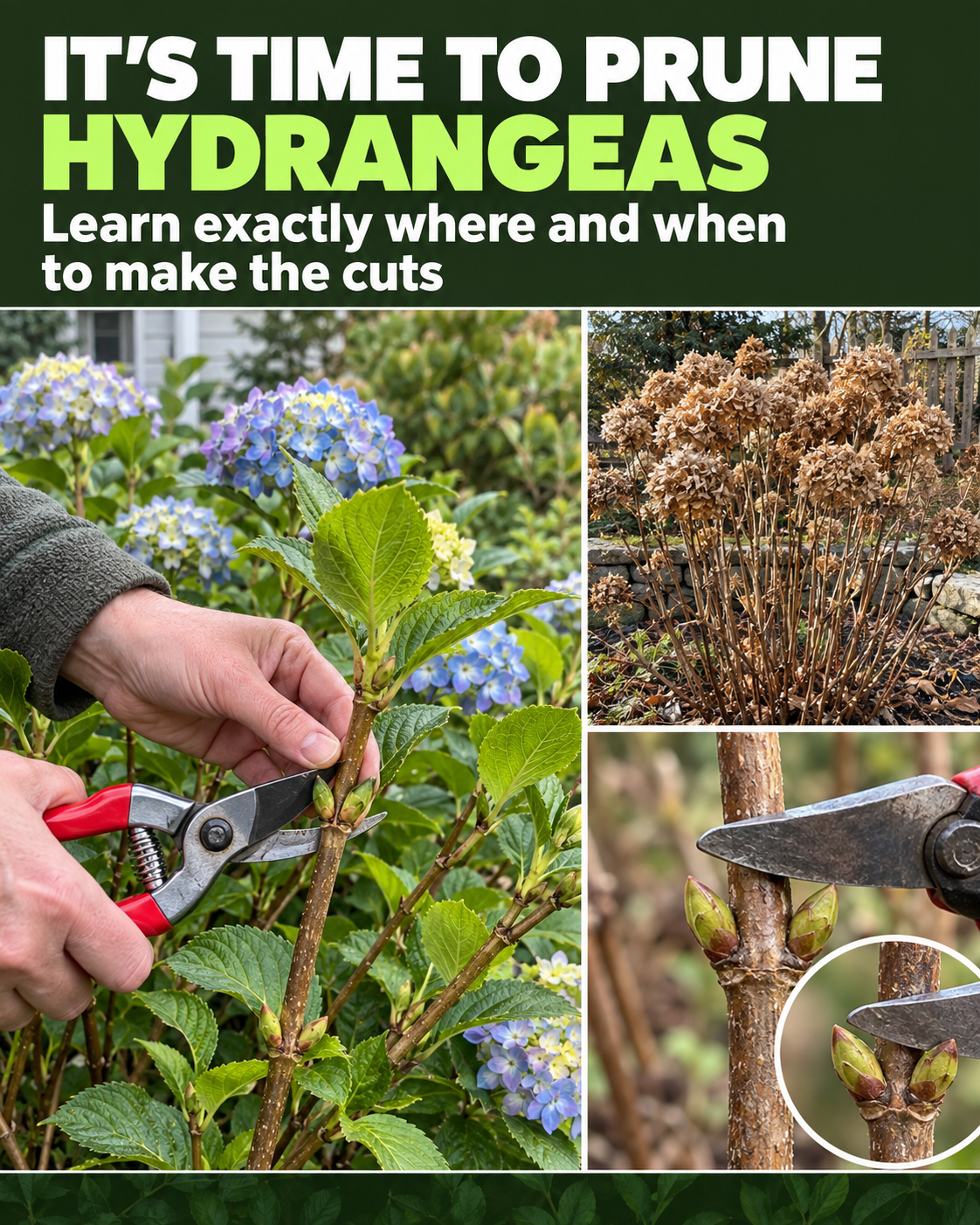
Time to prune hydrangeas? Here’s exactly when and where to make the cuts…
# Time to prune hydrangeas? Here’s exactly when and where to make the cuts…
Pruning hydrangeas has somehow earned a reputation for being ridiculously complicated. It really isn’t, once you know what kind of hydrangea you’re growing.
Some bloom on old wood, some on new wood, and some on both. Get the timing wrong and, yep, you can accidentally cut off next season’s flowers. So let’s make this simple. I’ll show you when to prune each type, where to make the cuts, and what not to touch. Let’s get into it!
Don’t forget to read the comments. I answered a lot of questions there!
Does Your Hydrangea Actually Need a Haircut?
pruning a hydrangea shrub
There’s actually something most gardeners won’t tell you: hydrangeas don’t need to be pruned hard every year. If yours is healthy, flowering well, and fits its space, you may barely need to touch it.
So why prune at all? Because the right cuts remove weak or damaged growth, open up a crowded shrub, and rejuvenate an older plant that’s starting to look a little tired.
But this is also where most beginners get nervous because you can make all the right cuts, but if you make them at completely the wrong time, you‘ll remove the stems carrying your next flowers.
So before you grab the pruners, you need to know what type of hydrangea you have, because that determines when it’s actually safe to prune.
Old Wood, New Wood… What Does That Even Mean?
Get My Christmas Cactus Care Ebook!
Unlock my full routine for big winter blooms! Watering schedule, light tricks, mistakes to avoid, everything you need for a healthier, fuller plant.
Website
Your Email…
Get the Free Ebook
We use your personal data for interest-based advertising, as outlined in our Privacy Notice.
One of the questions I get the most is: “What does old wood or new wood even mean?” And I get it, but it sounds much more complicated than it actually is.
Hydrangeas generally fall into three pruning groups:
Old wood: Stems that grew last year. So yes, literally older wood. The flower buds are already sitting on those stems waiting for their turn.
New wood: Fresh stems the plant grows this year. The flower buds form on that new growth.
Old and new wood: Reblooming hydrangeas can flower on both last year’s stems and the fresh growth they produce this season.
That’s pretty much it. The confusing part isn’t what old and new wood mean, it’s knowing which one your hydrangea blooms on. Two plants can look very similar and still need completely different pruning times.
Old-Wood Hydrangeas
If your hydrangea blooms on old wood, timing matters more than how much you cut!
These plants carry next season’s flower buds on stems that grew the year before, so pruning too late means cutting off the flowers you were waiting for.
The main old-wood hydrangeas are:
Traditional bigleaf hydrangeas (H. macrophylla): usually have large, broad, serrated leaves and those familiar mophead or lacecap flowers.
Mountain hydrangeas (H. serrata): look similar to bigleaf hydrangeas, but are usually smaller with narrower leaves and often lacecap-style flowers.
Oakleaf hydrangeas (H. quercifolia): the easiest to spot because their deeply lobed leaves look a lot like oak leaves.
Climbing hydrangeas (H. anomala subsp. petiolaris): a woody climbing vine that grows up walls, fences, and tree trunks rather than forming a typical shrub but it rarely needs routine pruning.
If you’re not sure which one you have, I added a photo of each one above that should make identifying yours a whole lot easier.
One little warning with bigleaf and mountain hydrangeas: some newer varieties are reblooming and bloom on both old and new wood, and they can look almost identical. I’ll cover those separately below.
Snip It, Don’t Strip It
For old-wood hydrangeas, the safest time to prune is shortly after they finish flowering. I prefer using the flowers as my calendar here rather than a specific month, because a hydrangea in Georgia can finish blooming much earlier than one in Michigan.
Once the flowers are fading, you can:
Cut off spent blooms just above a healthy pair of buds or leaves.
Remove dead, damaged, or weak stems back to healthy growth or all the way to the base.
Thin a few of the oldest stems at ground level if the shrub has become really crowded.
Lightly shape any branches sticking out awkwardly, rather than giving the whole plant a drastic haircut.
But if yours is still blooming into late summer, I’d skip the shaping! The big rule is don’t wait until fall, winter, or early spring to do your main pruning. By then, those older stems may already be carrying the buds for next year’s flowers.
And if you’re staring at bare stems after winter wondering, “Is this thing dead or just sleeping?”, give it some time. Once spring growth starts, healthy buds make it much easier to see which stems actually need to go.
Quick note: These steps work for most shrub-form old-wood hydrangeas. Climbing hydrangeas are the low-maintenance exception and usually only need pruning when they outgrow their space.
If you’re looking at those faded flowers and wondering what you’re actually supposed to do with them, we wrote a full guide on whether to cut hydrangeas back or leave them alone in fall.
New-Wood Hydrangeas
If your hydrangea blooms on new wood, you can relax a little. These are much more forgiving because they don’t carry next year’s flower buds through winter.
Their flower buds form on the fresh stems they grow that same year, so there aren’t already next season’s blooms sitting on the branches all winter.
The main new-wood hydrangeas are:
Panicle hydrangeas (H. paniculata): easy to recognize by their cone-shaped flower clusters, which often start white and turn pink, red, or green as they age.
Smooth hydrangeas (H. arborescens): usually have rounded flower heads, with ‘Annabelle’ being one of the best-known examples.
Cut It Before It Wakes Up
For new-wood hydrangeas, late winter to early spring is the best time to prune, while the plant is still dormant and before fresh growth really gets going.
This is another one where I wouldn’t obsess over a specific month. Spring arrives very differently in Minnesota than it does in Georgia. Watch the plant instead of the calendar! When it’s time, you can:
Remove dead, damaged, weak, or crossing stems first.
Cut panicle hydrangeas back as needed for shape and size, making cuts just above healthy buds. They tolerate pruning well, but there’s no reason to chop them nearly to the ground every year.
Prune established smooth hydrangeas harder if needed. They can be cut back to around 6 to 12 inches above the ground.
Leave young smooth hydrangeas alone for a season or two before giving them a hard prune so they have time to establish.
And don’t feel like you have to give either one a dramatic haircut just because it blooms on new wood. If the plant already has a good shape and size, a cleanup may be all it needs.
If yours is putting out loads of new growth but still not many flowers, don’t assume it needs more pruning. We also wrote a month-by-month guide on the best fertilizer routine for hydrangeas.
Old and New Wood Hydrangeas
If your hydrangea blooms on both old and new wood, you’ve got one of the more forgiving ones.
These are reblooming hydrangeas. They flower first from buds that survived on last year’s stems, then produce more flowers on fresh growth later in the season. So if winter cold or one unfortunate pruning session takes out some of the old buds, you still have another chance at flowers.
The main hydrangeas in this group are:
Reblooming bigleaf hydrangeas (H. macrophylla): look almost identical to traditional bigleaf hydrangeas, with large leaves and mophead or lacecap flowers.
Reblooming mountain hydrangeas (H. serrata): usually smaller and finer-leaved than bigleaf types, often with lacecap flowers.
Sadly, this time, a photo is usually not enough to identify yours! A traditional bigleaf and a reblooming bigleaf can look almost identical, so check the cultivar name or plant tag and look for words such as “reblooming” or “blooms on old and new wood.”
Two Chances, Still Don’t Go Crazy
Because these hydrangeas flower on both old and new wood, you have a little more flexibility with pruning, but that doesn’t mean they need a hard haircut.
If mine needs pruning, I keep it light:
Remove dead or damaged stems once spring growth makes it clear which parts are actually dead.
Deadhead spent flowers just above a healthy pair of buds or leaves.
Thin weak or crowded stems if the center has become too dense.
Shape the plant lightly rather than cutting the entire shrub way back.
If you need to do more shaping, you can prune in early spring or after the first flush of flowers fades. But let me warn you, there is a little catch.
Pruning in early spring can delay that first round of flowers, while pruning after the first flush can interrupt some of the reblooming that would have followed. So if, like me, you were already thinking, “Wait… is this the magical hydrangea I can prune whenever I want?” Nope. Not quite.
So with these, my rule is simple: remove as little healthy wood as you need to. They can give you two chances to bloom, but I still wouldn’t push my luck.
And since that second round of flowers often has to deal with the hottest part of summer, we wrote a guide on 7 things hydrangeas need during hot summer weather.
4 Pruning Mistakes Your Hydrangea Will Absolutely Hold Against You
If your hydrangea is huge, green, healthy… and apparently allergic to flowers, your pruning routine might be the reason.
Mistake 1: You Pruned at Exactly the Wrong Time
This is probably the easiest and most common way to accidentally cancel next year’s flowers.
Old-wood hydrangeas carry their future flower buds on stems that are already there, so cutting them back in fall, winter, or early spring can mean cutting those buds off too.
The plant survives. It grows plenty of leaves. You spend summer staring at it wondering what you did wrong.
Mistake 2: You Copied What Your Neighbor Does
Your neighbor cuts theirs back every spring and gets beautiful flowers, so naturally you try the same thing. Except they have a panicle hydrangea and you have a traditional bigleaf…
Different hydrangeas bloom on different wood, which means the exact same pruning routine can work beautifully for one and remove nearly every flower bud from another.
So identify yours before copying anyone else’s pruning habits!
And while we’re here, can we please talk about this little rhyme I keep seeing everywhere? “If it’s round, cut it down; if it’s a cone, leave it alone.” I have no idea who started that, but it’s WRONG!
Bigleaf hydrangeas can have round flowers and bloom on old wood (so don’t cut them down), panicles have cone-shaped flowers and bloom on new wood (so you can cut them back), and oakleaf hydrangeas have cone-shaped flowers but bloom on old wood (so leave those stems alone too). So much for the rhyme!
Mistake 3: You Got a Little Too Excited With the Pruners
I understand. Once you start finding stems that look awkward, suddenly everything looks like it needs cutting. But more pruning does not mean more flowers.
Start with dead, damaged, weak, crossing, or badly crowded stems. Then stop, take a look, and decide whether the plant actually needs more. A hydrangea usually needs a tidy-up, not a military haircut.
Mistake 4: You Declared a Stem Dead Before It Actually Was
Hydrangea stems can look impressively dead in early spring. Brown, bare, ugly… surely that thing is finished? Not necessarily.
Old wood can look lifeless while healthy buds are still waiting to wake up. If you’re unsure, give the plant a little time. Swelling buds and new growth will make it much easier to tell what survived winter.
Those ugly-looking stems may be carrying the flowers you’re about to cut off, so don’t hold the funeral too early.
Quick note: If you’re not sure whether a bare stem is dead, try the scratch test. Gently scrape a tiny bit of the outer bark with your fingernail. Green underneath means the stem is still alive, while brown and dry tissue usually means that section is dead.
And if your pruning looks right but you’re still getting leaves instead of flowers, we explain 7 other mistakes that can keep hydrangeas from blooming and how to fix them.
Don’t Overthink It, Just Know Your Wood
Pruning hydrangeas can feel a little terrifying the first time. What if I cut the wrong stem? What if it never blooms again? Did I just ruin the whole plant?
The good news is that one bad cut usually won’t kill your hydrangea. The bigger risk is pruning at the wrong time and accidentally removing the buds that were supposed to flower.
Once you know whether yours blooms on old wood, new wood, or both, everything gets much easier.
My advice? Start small, make only the cuts you actually need, and stop before you get too excited with the pruners. Hydrangeas are surprisingly forgiving, but they definitely remember a bad haircut when bloom season rolls around.